

General guidance only, not legal advice. This article provides general information for landlords in England. It does not apply to Wales, Scotland or Northern Ireland. Laws and procedures change, so always check current government guidance and seek professional advice for your circumstances.
Important update: Renters' Rights Act 2025. Section 21 no-fault evictions were abolished in England from 1 May 2026. Landlords who want a property back to sell or to live in must now use Section 8 Ground 1A (sale) or Ground 1 (occupation by the landlord or family). This guide reflects the law from 1 May 2026.
Key Insights
- You can still get your property back to sell or move in. Ground 1 (moving in) and Ground 1A (selling) are mandatory grounds. Prove them and the court must order possession.
- Four months' notice, not two. Both grounds need at least four months' notice, double the old Section 21 period.
- Not in the first year. The date in the notice must fall after the tenant's first 12 months in the property.
- The 12-month lock-out is real. After using either ground, you cannot market or re-let the property for 12 months.
- Evidence wins. You must prove a genuine intention. "I might sell" is not a ground.
Can a landlord still evict a tenant to sell or move in?
Yes. Since Section 21 was abolished on 1 May 2026, landlords in England recover possession for these reasons using two mandatory Section 8 grounds: Ground 1 if the landlord or a close family member will move in, and Ground 1A if the landlord intends to sell. Both need at least four months' notice and cannot take effect in the first 12 months of a tenancy.
Because both grounds are mandatory, the court has no discretion once the ground is proved. The catch is the word "proved". Under Section 21 you never had to explain yourself. Under Grounds 1 and 1A, the reason is the whole case.
Ground 1: moving in yourself or housing family
Ground 1 applies where the landlord, or a qualifying close family member, intends to occupy the property as their only or principal home.
Qualifying family includes a spouse, civil partner or partner, parents, grandparents, siblings, children and grandchildren, including those of a spouse or partner. Check the exact wording of the Act before relying on a more distant relationship. Where there are joint landlords, the ground can be used for any one of them.
What the court will want to see:
- A clear, current intention to live there, not a vague future possibility.
- Why this property, and when: a job move, a separation, a family member who needs housing.
- Documents that back it up: correspondence, a planned move date, evidence that the current home is being sold or given up.
Ground 1A: selling the property
Ground 1A applies where the landlord intends to sell the property. GOV.UK's own example of evidence is showing that you have instructed an estate agent and a solicitor.
Strong evidence looks like an estate agent's instruction or valuation, a conveyancing solicitor on file and a documented reason for selling, such as refinancing, retirement or restructuring a portfolio. Weak evidence looks like "testing the market".
Selling to an investor who will keep the tenant? You don't need Ground 1A at all. A sale with a sitting tenant avoids both the four-month notice and the 12-month re-letting restriction.
Ground 1 vs Ground 1A at a glance
| Ground 1: occupation | Ground 1A: sale | |
|---|---|---|
| Purpose | Landlord or close family moving in as their only or principal home | Landlord intends to sell |
| Type | Mandatory | Mandatory |
| Minimum notice | 4 months | 4 months |
| First 12 months of a tenancy | Date in the notice must fall after them | Date in the notice must fall after them |
| After use | Cannot market or re-let for 12 months | Cannot market or re-let for 12 months |
| Typical evidence | Move plans, reason, correspondence | Estate agent and solicitor instructed |
Sources: GOV.UK, Guide to the Renters' Rights Act and GOV.UK, Repossessing your privately rented property after 1 May 2026.
When can I serve notice under Ground 1 or 1A?
You can serve the notice before the 12-month point, but the date in the notice must fall after the tenant has been in the property for 12 months. In practice, that means the earliest you can serve is around month eight of a new tenancy, giving the full four months' notice so that it ends after month twelve.
Get the dates checked before you serve. A notice whose date falls inside the first 12 months is invalid, and restarting a four-month clock is the most expensive mistake on this page.
What is the 12-month re-letting restriction?
After using Ground 1 or Ground 1A, you cannot market the property to let or re-let it for 12 months. The rule exists to stop the grounds being used as Section 21 by another name, and breaching it exposes you to local authority enforcement, including civil penalties.
In practice, decide before you serve. If the sale stalls after the tenant has gone, you cannot simply put a new tenant in. Plan for that outcome now, not after the keys come back.
Before you serve: the compliance check
Both grounds are mandatory, but a mandatory ground still fails if the paperwork underneath it is wrong.
- Deposit. Protected in an approved scheme, with prescribed information served. A landlord who hasn't properly protected the deposit cannot get possession on these grounds until that is put right.
- Private Rented Sector Database. Once registration is required, an unregistered landlord cannot get a possession order on these grounds.
- Tenancy paperwork. Written terms in place, and the government information sheet given to tenants whose tenancies existed before 1 May 2026.
- Property standards. Gas safety record, electrical safety report, EPC, smoke and carbon monoxide alarms. Tenants can raise disrepair as a counterclaim, which adds months even when the ground is clear.
- Evidence pack. Assembled before the notice goes out, not after the tenant disputes it.
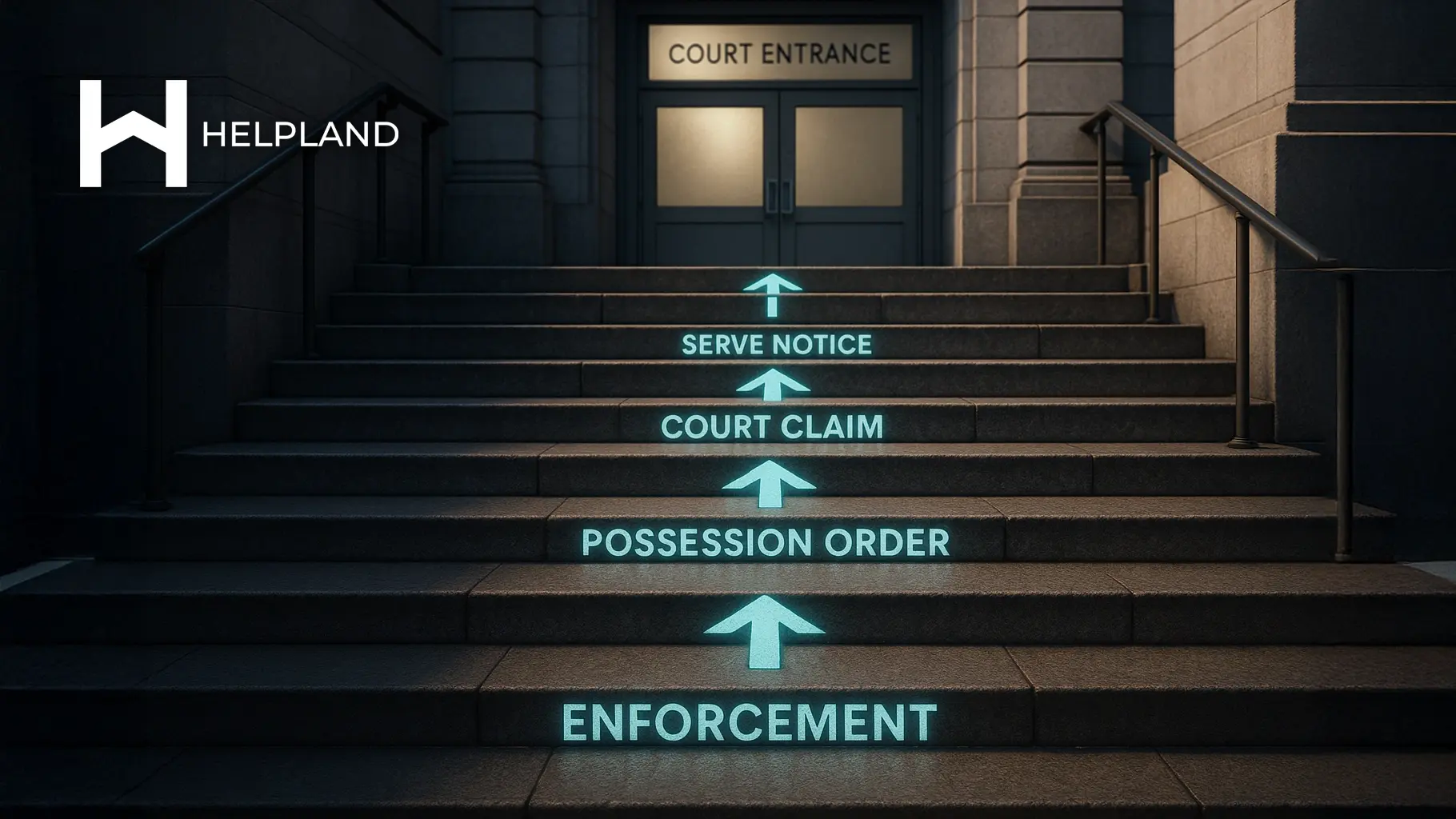
Step by step: from notice to possession
- Check compliance and confirm the earliest valid date.
- Serve a Section 8 notice on Form 3A citing Ground 1 or Ground 1A, giving at least four months' notice. Keep proof of service.
- Wait for the notice to expire. Many tenants leave within the notice period.
- If they don't, issue a possession claim on paper forms N5 and N119 (court fee £415). The accelerated procedure was the Section 21 route and isn't available here, so expect a hearing.
- Attend the hearing with your evidence. If the ground is proved, the court must order possession.
- If the tenant still won't leave, apply for a warrant of possession for County Court bailiffs, or apply to transfer to the High Court for a High Court Enforcement Officer.
More on the court stage in our Possession Order Guide for Landlords.
Common mistakes that cost landlords months
- Putting a date in the notice that falls inside the first 12 months.
- Citing the wrong ground or the wrong notice period.
- Turning up at court with no evidence of intention.
- Discovering an unprotected deposit at the hearing.
- Using Ground 1A as a workaround for a problem tenant. If the real issue is arrears or behaviour, use the ground that fits. Misuse risks penalties and leaves you unable to re-let.
- Re-letting within 12 months because the sale stalled.
How Helpland can help
Recovering a property to sell or move in is now a four-month, evidence-led process, and a flawed notice means starting again. Helpland is one of only two NRLA-recommended eviction specialists in England and Wales, with over 20 years' experience, fixed fees, court representation included and a dedicated account holder from notice to keys.
- Section 8 Notice service: drafted and served correctly the first time.
- Section 8 Court Proceedings: claim, hearing and representation handled.
Book a free landlord consultation at helpland.co.uk.
Frequently Asked Questions
Can I evict a tenant to sell my house in 2026?
Yes, in England you use Section 8 Ground 1A. You must give at least four months' notice, the date in the notice must fall after the first 12 months of the tenancy, you must be able to prove you intend to sell, and you cannot re-let or market the property to let for 12 months afterwards.
How much notice do I give a tenant if I want to sell?
At least four months under Ground 1A. The two-month Section 21 notice no longer exists in England.
Can I evict a tenant so my son or daughter can move in?
Yes. Children are qualifying family under Ground 1, provided they intend to live there as their only or principal home. The same four-month notice and 12-month rules apply.
What happens if my sale falls through after the tenant leaves?
The 12-month restriction still applies, so you cannot market or re-let the property during that period. Plan for this before serving notice, including whether a sale with a sitting tenant would suit you better.
Do Grounds 1 and 1A apply in Wales?
No. Wales operates under the Renting Homes (Wales) Act 2016, where landlords can still end a standard occupation contract without giving a reason, using a section 173 notice with at least six months' notice. See our guide to evicting a tenant in Wales.
This article provides general guidance for landlords in England only and does not constitute legal advice. Laws and court procedures may change. Always check current government guidance and seek professional advice for your circumstances. Last reviewed: November 2026.